
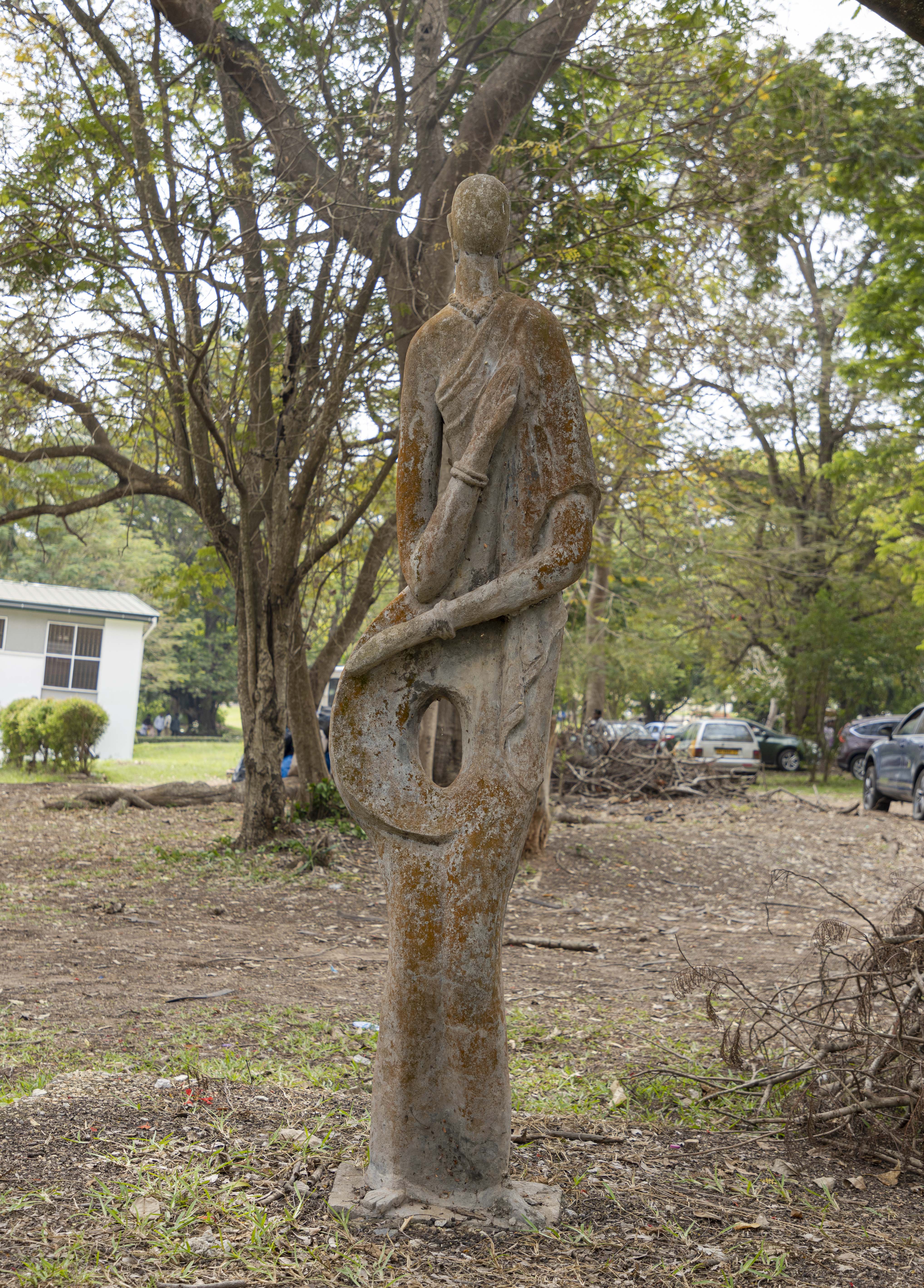
Tucked among trees and surrounded on all sides by Independence Hall, Republic Hall, Unity Hall and Hall 7 on the Kwame Nkrumah University of Science and Technology (KNUST), Kumasi campus stands a tall, slender sculpture known as Lonely Woman.
Many people pass by it without stopping. Others glance at it and move on. Yet the sculpture has been standing there quietly for decades.
Made in the early 1960s by KNUST student John Christopher Osei Okyere, Lonely Woman is built from raw concrete. It rises to about three metres high, making it taller than most people. Its surface is rough and weathered, marked by time, rain, algae and dust.
At first glance, the figure looks human, but not in a realistic way. The body is long, narrow and upright, almost like a pillar. The face has no clear features: no eyes, no mouth, no expression.
The arms are bent in an unusual way. One arm is raised, with the hand resting gently on the chest. The other is lowered and pressed close to the body. The pose feels calm, but also slightly tense, as if the figure is locked in perpetual contemplation.
One of the most striking things about Lonely Woman is that it is not clearly male or female. From afar, some people think it is a man. When they move closer, signs usually associated with a woman appear: rounded chest forms, jewellery-like shapes and soft curves around the hips. The sculpture seems to carry both identities at once, refusing to settle into a single category.
This deliberate ambiguity gives the sculpture its power. It suggests that identity is not always simple or fixed. Instead of telling viewers what to think, the sculpture allows them to decide what they see a concept that quietly reflects the spirit of the university itself.
Looking at the back of the sculpture reveals another surprise. The shape of the torso resembles an acoustic guitar, with carved lines that could be read as either folds of cloth or musical strings.
This playful visual idea connects the human body to sound, rhythm and creativity. Some viewers may also notice a hollow opening near the lower body: a carefully shaped void that invites the eye to look through it. Here, empty space is just as important as the solid concrete that surrounds it.
Lonely Woman is not truly alone. With the spirit of Nyansapo guarding it through the years, and generations of students passing by, some pausing to stare, others offering a smile, the sculpture is assured an enduring place at the heart of the campus.
Adapted in part from J. C. Okyere’s “Bequest of Concrete Statuary in the KNUST Collection: Special Emphasis on Lonely Woman” (January 2015) Kąrî'Kạchä Seid’ou – Kwame Nkrumah University of Science and Technology
By: Emmanuel Kwasi Debrah


